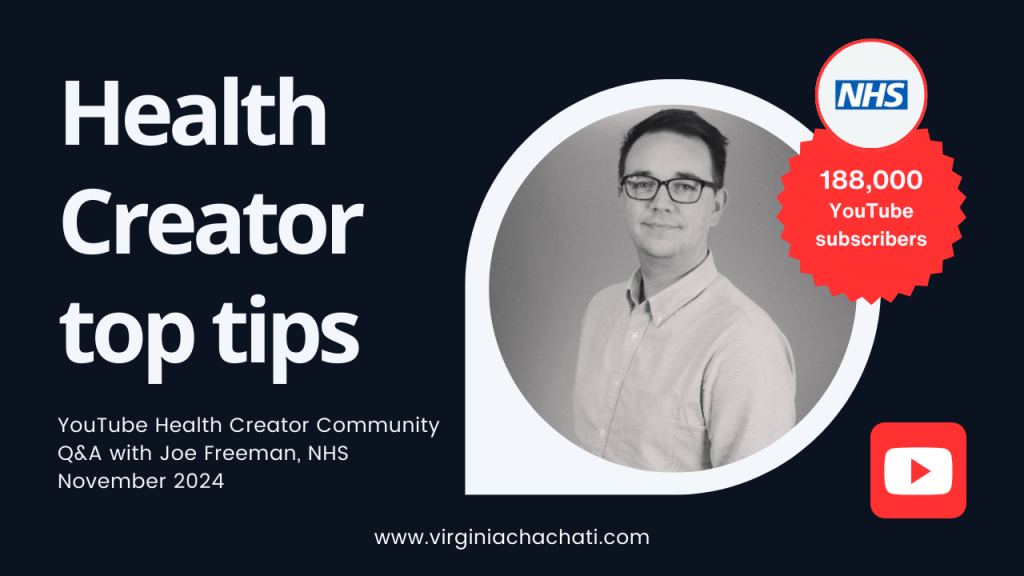
I attended the YouTube Health online community session in November, hosted by Vishaal Virani, Head of Health at YouTube UK & Ireland.
This session featured a Q&A with Joe Freeman, Deputy Head of Social at NHS England.
Please note: I (Virginia) wrote this article, and it was very kindly reviewed & edited for accuracy by Joe Freeman.
Joe said YouTube Health’s mission broadly aligns with that of his team, and there are billions of searches for health queries on YouTube so it makes sense to be there, sharing content on a platform used by so many people.
YouTube Health’s mission:
“We are committed to ensuring that everyone can learn from leading medical experts regardless of who they are or where they live. To combat the societal threat of medical misinformation, we’re working to fill the health information space with digestible, compelling, and emotionally supportive health videos.”
For the NHS channel on YouTube, Joe said its main goals are:
- to help people on their journey to get the support they need
- learn how to access and use NHS services
- to be discoverable
- maybe be the first video people find when they are looking for information
Joe said one challenge of being the first people find is it’s more difficult to be found as the quality of content on YouTube becomes better overall. But if the quality of content is increasing across the board, what’s important is people are getting trusted, authoritative information and advice that will help them.
Who do you make your videos for?
- 18 to 34 year olds, because they don’t generally access information on NHS.uk (older people do)
What do you base your videos on?
- Content on the nhs.uk website
- Top queries from NHS 111
- NHS England and DHSC campaigns
What type of videos do you create?
- We help people find information on subjects that matter to them
- How to access NHS services if they need them
- Health conditions (and signpost from there)
How do you create your videos?
- We generally focus on the beginning of people’s journey, not content that goes in depth on their condition
- For example, people who have signs and symptoms of a health problem, and want help
- We focus on people who want specific info on a specific topic
- Search is where it’s at, it’s grown to become the primary source of traffic for most of our content
How do you know what kind of videos people want?
- We did research and spoke to real people – showing them videos and asking questions
- We found out the NHS brand is important for viewers to be able to trust content
- They do not need a doctor on screen necessarily, so we created animations
- With animations we can edit them easily, rather than find the person who filmed the video and film it again. This helps us update content more quickly when required
- People like shorter videos that answer direct questions. Our videos are quite short (around 2/3 minutes)
- We tested a lot of video titles and thumbnails – these are really important!
- We used to get c2% Click Through Rate (CTR) now over 7% which means it’s working
- It’s important the videos answer people’s questions and meets their expectations
How long does it take to create videos?
- We wanted a video every 2 weeks, but it can be 4 weeks to get videos published.
- We have to be accurate, and we take it seriously – we have to give people the right information.
- It gets easier and quicker as we do more of it, and the more familiar people are with how we do things. (Several people are involved in the sign off process).
- We made Shorts with creators and also in-house. They are a quick and easy way into the world of YouTube.
- YouTube is an investment of time and effort but for us results are paying off
What do you think about Shorts?
- We’ve been fortunate to collab with really great people (like Dr Aziza Sesay, Pharmacist Virginia Chachati, Dr Sophie Newton, Dr Simi Adedeji).
- It’s important to have real people in Shorts – someone engaging who knows what they are doing and seems to be trustworthy.
- Great to leverage Shorts to get more views and sign post to longer form content.
- Shorts are good to drive up subscriber numbers too.
What has made your YouTube strategy successful?
- We get around 65 to 70% watch time on our videos
- Success is due to our topic slection, seo research, titles and thumbnails – it’s clear what they people get when they click so they are (hopefully!) not disappointed
- Around 50% of views come from YouTube search now, which is increasing – and shows our approach is working
Where else can videos go?
- Videos take time and effort, so we want to find other uses for them off YouTube.
- We could embed videos in clinical pathways, get them into urgent and emergency care pathway when they call 111, or text them our video
- I’d love to get our content into GP practices, healthinote or AccuRx (GPs use AccuRx to send text messages – maybe to direct them to a video about using an inhaler can they refer to that again rather than make another appointment support them rather than go to GP again – visual aspect of videos is very valuable for guidance).
- Videos can save GP time and avoid repeat appointments (not that we discourage them from going)
- We want to ease pressure off the NHS and NHS 111, and align with public health campaigns
- I want to be a bit more reactive and know what’s happening in the moment and create videos that people need and put them out quickly in future
- Maybe we can leverage creators who have existing great content, or ask them to create videos with a quick turnaround time
Follow Joe on LinkedIn: https://www.linkedin.com/in/joe-freeman/
 Virginia Chachati
Leave a comment