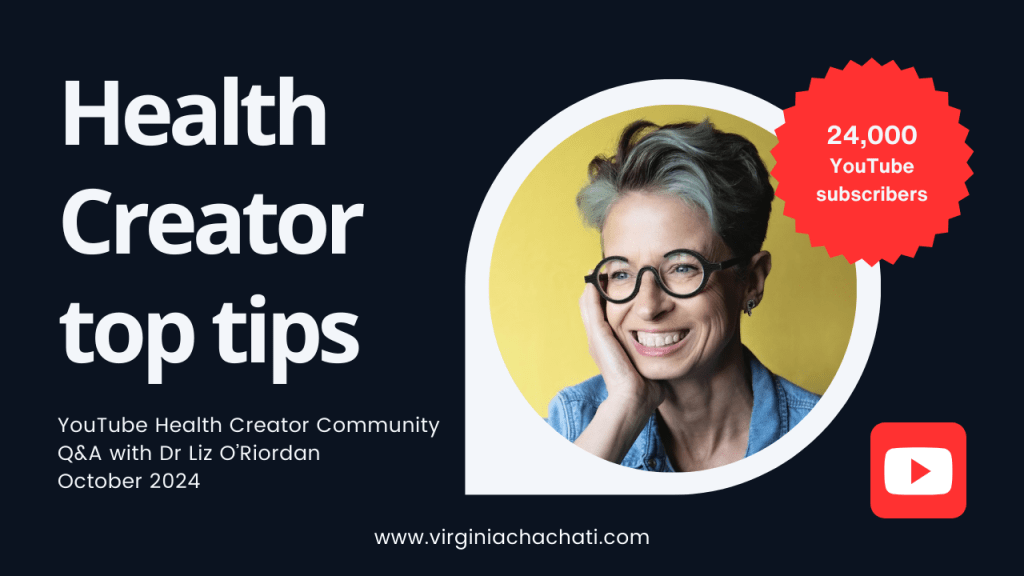
Dr Liz O’Riordan is a retired breast surgeon who has had breast cancer three times in her life. She has authored three books: Under The Knife (her memoir), The Complete Guide to Breast Cancer, and The Cancer Roadmap (coming out January 2025).
So what motivates her to create health education videos for the masses?
With an impressive 74,000 followers on Instagram, 67,000 on X (Twitter), and 24,000 on YouTube, plus a podcast (So now I’ve got breast cancer), she knows a thing or two about creating content!
At the YouTube Health Creator Community session in October, hosted by Vishaal Virani (Head of Health at YouTube UK and Ireland), Liz shared her story and top tips.
What did publishers tell you when you wanted to publish your memoir, Under The Knife?
Publishers liked my memoir but said they’re not interested because I talk about rescuing hedgehogs and making my own clothes. I only had 2000 followers on Instagram. They said to come back when I have 10,000.
I spoke about breast cancer and got 12,000 followers in 6 months, and they said they still they didn’t know how to market it.
I crowdfunded it in 10 days from my community.
Vishaal Virani asked you to join the YouTube Health shelf, why did you go for it?
I needed a library of content because I have 300 to 400 videos on Instagram.
When people asked if I had a video about something, I would scroll down to try and find it, which wasn’t great!
I thought having searchable content would be good idea, so YouTube was good for that.
I had no idea how much hard work it would be, although I can see the benefits now.
What keeps you motivated to create videos?
- I’m retired so I have the time to put effort into this
- I’m enjoying learning new creative skills
- Finding new ways of reaching people
- Explaining cancer terms in simple language
- I am having fun coming up with props for videos e.g. I smashed an apple with a meat hammer!
- People ask me questions, I love being able to help them
How did you get started with creating health education videos?
- I didn’t know what CapCut and Da Vinci was (they are video editing software)
- I used to write scripts, try to remember them, and film on my phone
- I spent a lot of time and research on books, and how to get monetised on YouTube etc
- I spent 6 months uploading all my Instagram videos to YouTube
- I uploaded 3 to 4 videos per week for the algorithm because people said consistency is key
- Now subscribers grow because of old content
- I need to tell YouTube what they are searching for not what I want to tell them
- My Instagram and YouTube audiences are very different – the same short video will get 1million views on Instagram but only 2000 on YouTube! But YouTube is a search engine.
How do you make your health videos?
- What people search for is my content
- I have a PIF TICK certification
- I take 8 hours to research and script a 5 to 10min video – I want to make sure it’s accurate and evidence-based. Then I read it out loud – it’s different to talk it rather than read it. Then I use hemingwayapp which says things like this is a long sentence, it’s hard to read.
- I pay a local guy who films me and edits my videos – I was taking 8 hours to edit my first video! My time is precious.
- I learnt Canva Pro has a load of amazing medical b roll you can get rather than pay on Shutterstock – it takes time to plan all of that
- Then the captioning and translating it takes a lot of time and effort but for me having that content out there, it’s great
- The bugger is the thumbnail for YouTube – I didn’t know what it was – I spent 48hours trying to design my first one. You don’t know what’s going to work and what isn’t that’s why I love a/b testing.
- My first video is different to now
- I do shorts and copy and replicate things like Dr Julie
- I’m learning how to have a good hook and building up the tension in a video, how do you keep them watching as well as getting the info out there
What are your plans for your YouTube channel and more broadly?
I’m publishing my third book, The Cancer Roadmap. It came off an Instagram Reel – after I debunked the happy pear who said magic mushrooms cure breast cancer (not true!) – Harper Collins asked me to write the book.
I’ve not published a lot this year as I am dealing with side effects from my cancer treatment, and my father passed away in June 2024.
I am working on a podcast. I now put out a long form video every 2 weeks and short video every 1 or 2 weeks.
I want to become the woman people go to to get sensible info about cancer that people can trust. And try to reach as many people as possible and answer their questions.
It’s the community.
I focus on Instagram and YouTube communities, not really TikTok or the others.
I also do talks about cancer care, resilience, and leadership.
What do you think of doing brand deals?
- Don’t believe in doing brand deals or endorsing products I don’t use (sweatshirts, supplements, facial cleansers…)
- A US company asked me to do a Reel on breast cancer and myths. I charged four figures per Reel to do it.
- I think (doing brand deals) would dilute my channel – I know I lose money because of that – but I feel strongly about it. It just doesn’t sit right with me.
- I don’t judge anyone for doing it
What has your journey with book publishing been like?
- The publishing industry is broken
- I bought 10 books written by breast cancer patients when I was diagnosed and Trish bought 10 books
- We wanted to get sensible info out there because there is so much BS online
- You find an agent who represents authors you like – I found one pure non fiction agent and I emailed her. Her sister died of breast cancer going down alternative route so she wanted to support us.
- If it’s non fiction, you write 3 chapters, send it to publishers, they give you an advance (money). It was a 7k advance, then the agent got it up to 10k
- You say how long it will take you to write the book
- After a bidding war, Penguin paid a 15k advance between Trish and me. It took a year to deliver The Complete Guide to Breast Cancer
- It took 4 years to break even
- You have to earn the advance back in royalties
- And I get 60p per book because I split it with Trish
- To publish my memoir, I went to Unbound who gave 50% of royalties at the time (now it’s 10%)
- I had to raise 17k, but they give you tips on how to do it, like charged 500 for a talk
- It’s hard work asking strangers for money – I did it in 10 days purely on my social media following
It takes 18months from signing a contract to actually publish. They might delay it by 2 years for Christmas or other authors are coming out with a book (like celebrities).
What have been the benefits of writing a book?
By researching a book about cancers, I have 50 chapters written that are YouTube videos or shorts.
It’s a hard slog. Don’t do it to make money.
It’s much quicker and cheaper to self-publish on Amazon, print on demand, and make £4 per book
Get in touch with Liz to chat about publishing
How did you stay motivated in the beginning when creating health videos?
- I was close to quitting – I got 2 subscribers a week on YouTube but 100 on Instagram
- What helped was having content in the back
- I had no idea about SEO (Search Engine Optimisation)
- Just, in time, people will find your videos
- My YouTube audience is younger and more international than my Instagram and TikTok
- What kept me going is I am going to make videos for Instagram and I may as well put them on YouTube and then I have a library of content I can send people
- I’m not in this to make money or make a massive community
- It’s hard work I wish I could quit but I can’t
- I am an expert in breast cancer and they will always be my main audience
- Now I want to reach a broader audience – it’s nice to talk about something different and what challenges me
- I’m an expert on both sides of the table – I want to explain what is cancer, why it happens, and debunk the myths
What’s the difference between practicing and being a retired clinician?
- I need to make sure I stay on top of latest research
- I double check with oncologists and radiotherapists to make sure what I say is accurate
- Remember you don’t know everything
- I am try to remember what it’s like to be a chemo patient 9 years ago – my audience is someone in their first year of diagnosis, that’s how I focus
How often do you post health videos and do you take breaks?
- I’ve now stopped expecting a similar growth level on YouTube to Instagram – I’m not obsessed about growing
- My focus is on putting the best info out there
- It’s very slow growth
- I used to think I’m so bad. What’s the point? It just takes time.
- Don’t feel guilty about not giving viewers something to watch
- Having more subscribers is good because it’s accountability
- It’s nonsense to put out content every week or every day, you are doctors, you are busy, and life happens
- Have to be in this for long term
- I do batch filming to get content for 3 weeks – I will just change my top for each video and film on a Sunday.
- I use Metricool or YouTube studio to schedule videos
- That bank of content will keep doing views even in your absence
When you film do you think of it as content for Instagram or YouTube or TikTok? Do you post a different video for each channel?
I’ve ignored TikTok. I film 1 video with my phone and put it on Instagram, and some of them make it to YouTube (Instagram is my bigger community). Long YouTube videos do not get watched on Instagram.
I have a script and film for under 60seconds. I film it once – life is too short.
I even rant on a dog walk and put it on YouTube Shorts.
I use CapCut to caption it, with maybe slightly different captions for each platform.
On Instagram, I use ManyChat to direct comments to direct messages to links to a podcast or book.
I will put a clip from long YouTube videos and use ManyChat to say follow the link to go to YouTube.
It’s all about clickability.
Virginia got me onto promptsmart and I got Elgato. So there is the script on screen and I can see myself filming.
Making health videos has gotta be easy for us to do because we are busy.
 Virginia Chachati
Leave a comment