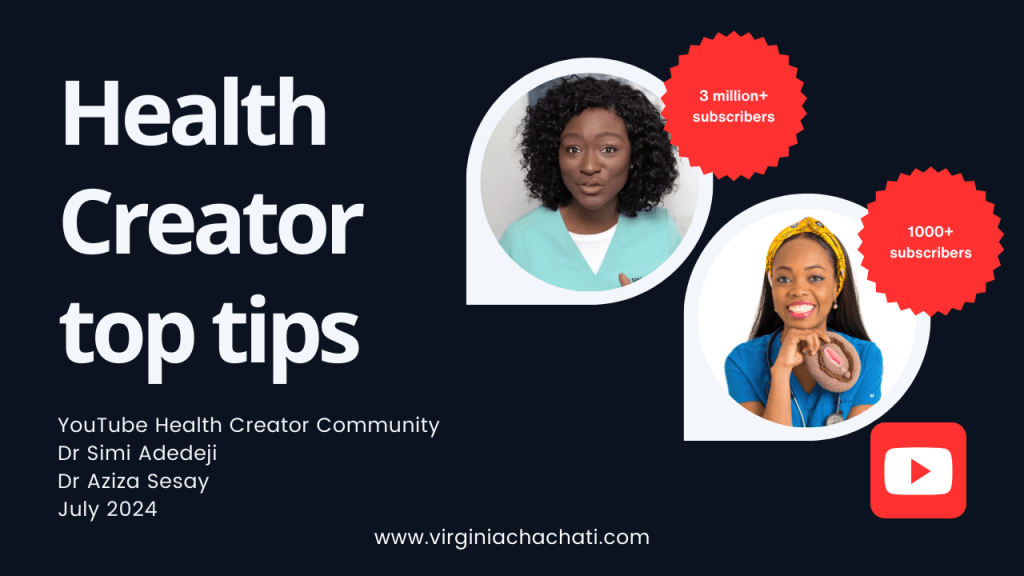
I attended the online YouTube Health Creator Community UK session for July 2024 – with the fantastic women’s health creators Dr Simi Adedeji and Dr Aziza Sesay!
Here’s a quick overview of what happened:
- Updates from Dr Vishaal Virani, Head of YouTube Health UK & Ireland
- Marie from YouTube talks about YouTube content policy – yellow icons and monetisation (what to avoid when it comes to images for health content)
- The main event: Q&A with Dr Simi Adedeji and Dr Aziza Sesay
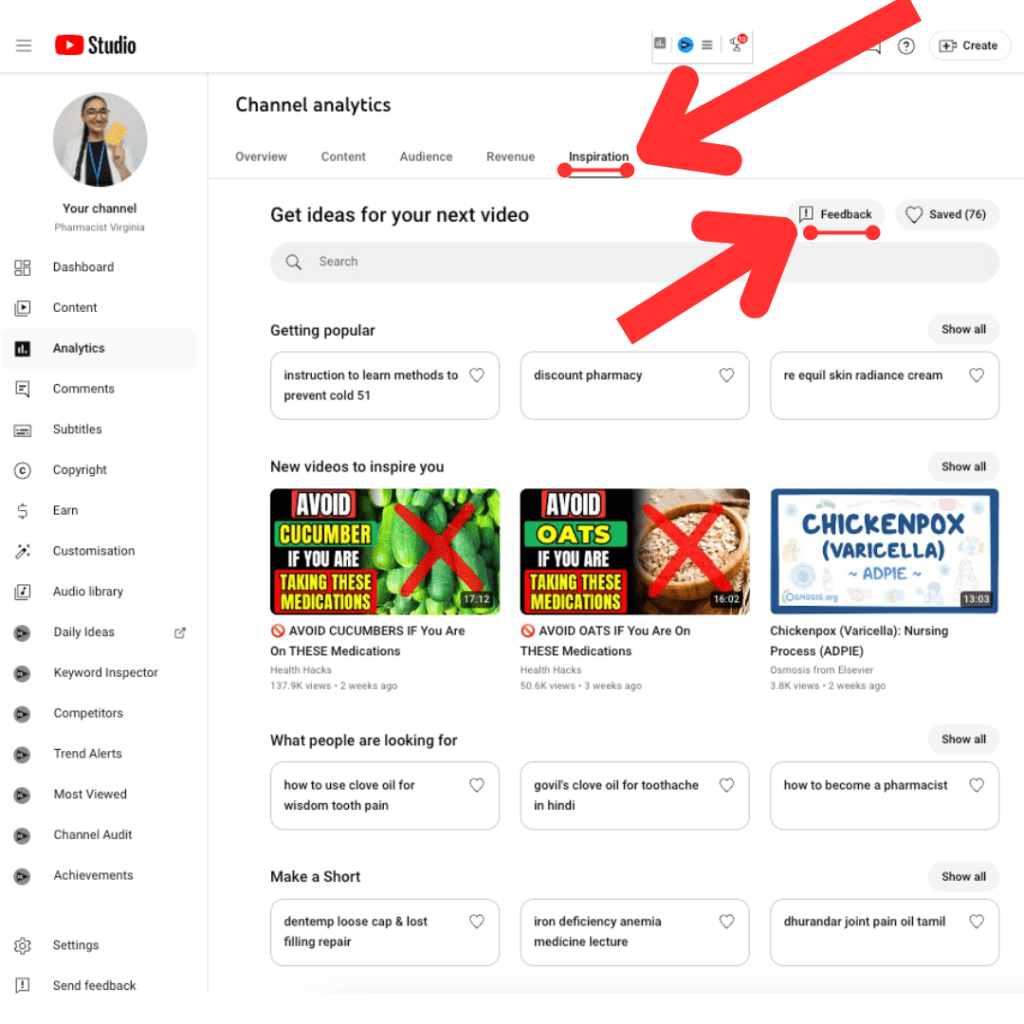
New in the YouTube studio: Inspiration tab
- This replaces the previous “Research” tab under “Analytics” in YouTube Studio.
- Watch out: Some videos can be questionable, and sensational often not from authoritative health sources.
- Please let the YouTube team know what you think via the feedback tab in the top right.
5 Juicy Official YouTube Creator resources to help you
- Official YouTube Creators website with tips
- YouTube creators channel
- Creator insider channel
- Behind the Thumbnail video series with health creators
- YouTube Culture and Trends Report 2024
Inspiration from Vishaal, Head of YouTube Health UK & Ireland
“Health content on YouTube is truly evergreen – but also YouTube is a slow burner and it can take quite a long time for your content to grow. So please don’t be disheartened if you upload a few videos and 3 to 6 months later you don’t have many views. Genuinely, views start to come in a little bit later. You just need patience – hang in there and keep uploading and you’ll start to get views.”
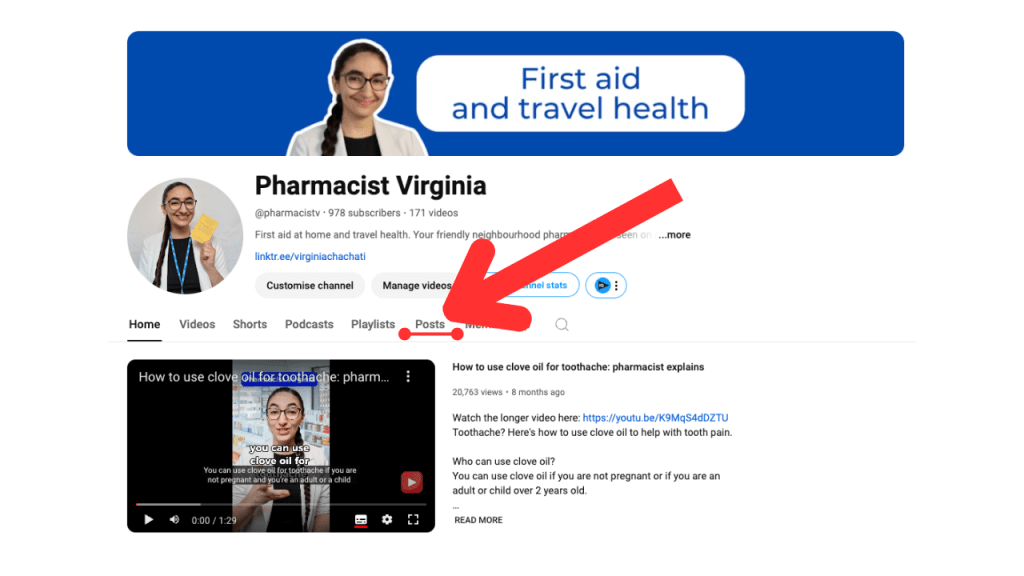
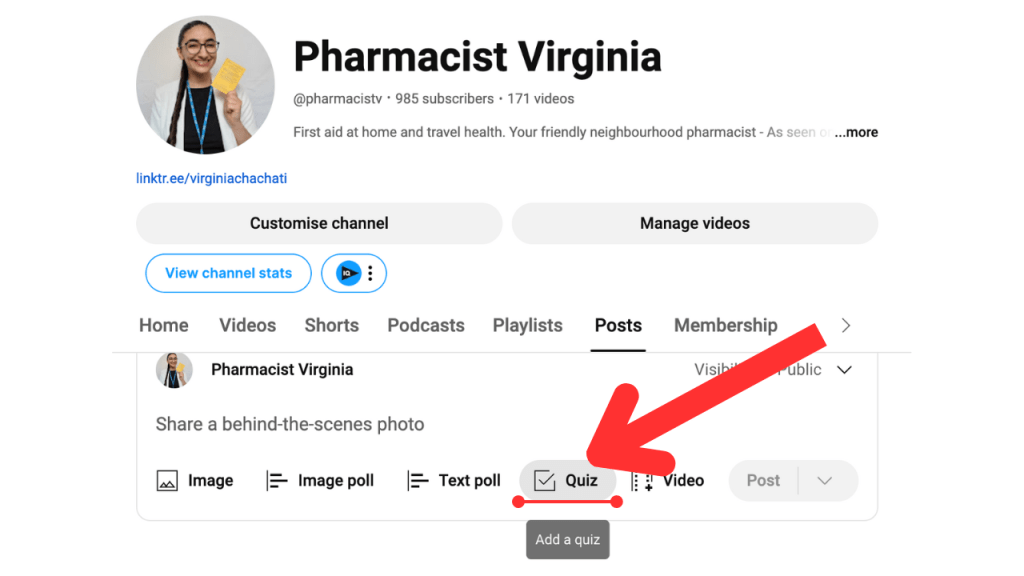
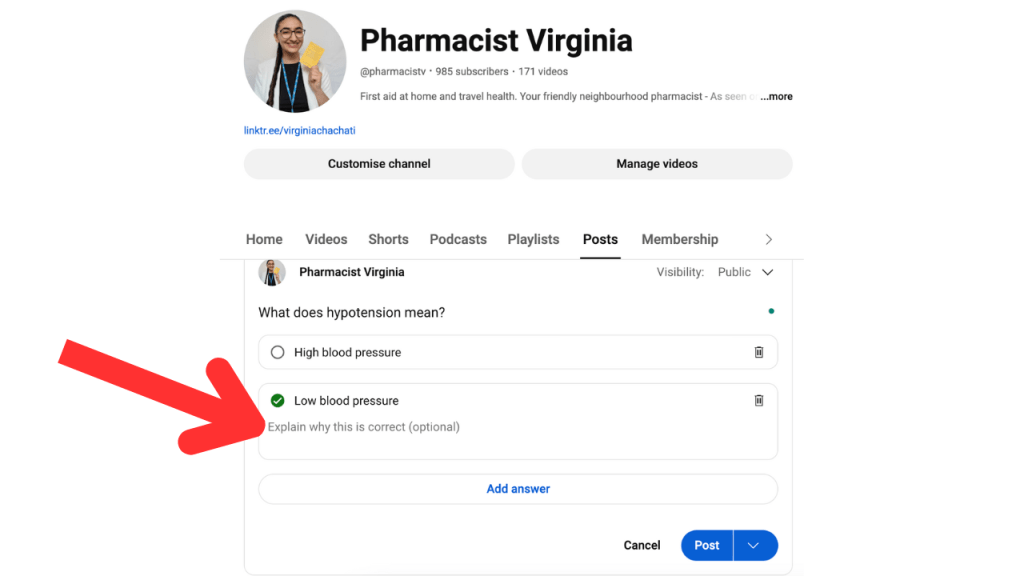
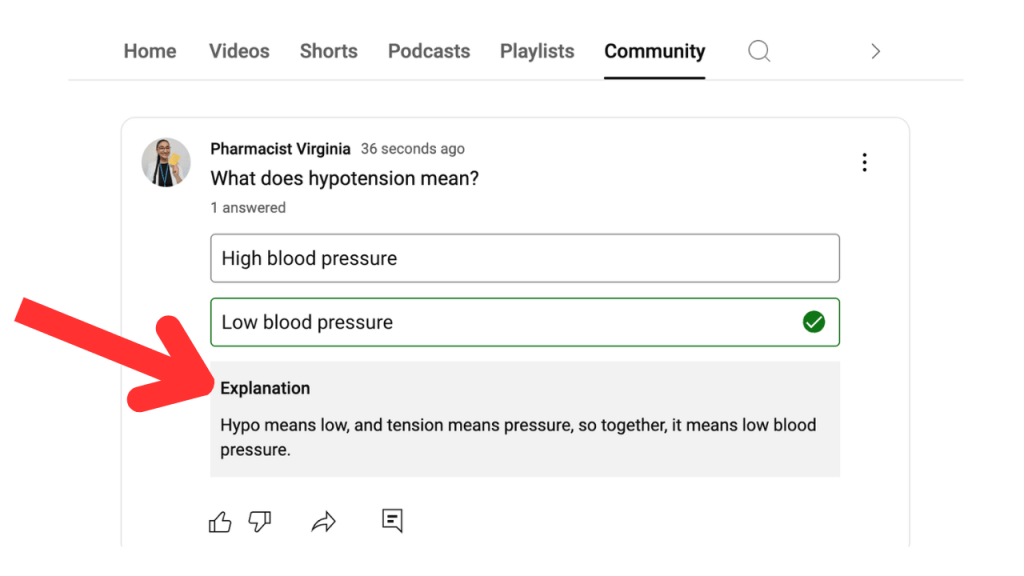
Post a quiz in your Community tab also known as Posts
You can use quizzes in your Community tab – this has now changed to the “Posts” tab on some channels. Find out what your community on YouTube knows about, or what their health assumptions might be about certain topics, such as breast cancer.
YouTube Partner Program: How to overcome challenges with nudity and shock factor
- Marie talks about health creators who are part of the YouTube Partner Program (YPP). See how to join the YouTube Partner Program here.
- Green $ icon = fully monetised video, so most advertisers can advertise on your content (and you get paid for this).
- Yellow $ icon = Limited advert rating, so some brands have opted out and you will get a reduced amount for adverts placed on or in your video, which means less money for you.
- Best to use diagrams and cartoons and less realistic version of nudity
- Photos and videos with “realistic look nudity” = yellow icon
- If you think there has been a mistake, you can appeal the video
- Even if it’s a 2D image or lifelike version of nudity it can lead to a yellow icon
- Use diagrams cartoons medical models that are 2D and not lifelike for higher chance of a green icon.
- For shock factor, such as pimple popping, or realistic body fluids, gorey or looks like real blood on the thumbnail, this is more likely to lead to a yellow icon – even if it is educational
- If your thumbnail is yellow iconed, then the whole video will be yellow iconed too!
- If there is an issue with a video that completely demonetises it (so you earn no money from it), there will be a specific timestamp that shows when the issue appears in the video (for example between 30 seconds and 1 minute in your video). You can then appeal the video.
If I’m a health brand, can I still apply for the YouTube Health Shelf?
- You will not be accepted if you have mostly testimonial videos and just 1 or 2 educational videos.
- You need to have mostly educational videos (at least more than 50% of the channel) for the YouTube team to be more likely to accept the channel onto the YouTube Health Shelf.
- “Great place to work videos” are not health education but okay to include.
- There should not be health misinformation, even in testimonials.
- If you’re a doctor applying for the YouTube Health Shelf on behalf of the health brand, you have to decide if you want your GMC number to be attached to that brand or organisation, and how much trust you place in them.
YouTube Health Shelf not active in Middle East
- If you have a Middle Eastern medical registration, then you cannot apply for the YouTube Health Shelf, but you can if you are registered in the UK, US or Canada or other regions. See the requirements for the YouTube Health shelf here.
Q&A with Dr Simi Adedeji and Dr Aziza Sesay
Note from Virginia Chachati: Please note I am mostly paraphrasing in this write-up.
Dr Simi Adedeji self-introduction
- GP, also known as family medicine physician.
- GP partner – I own and run my own GP practice, so the business side and seeing patients too.
- Special interest in dermatology, so I have a clinical diploma in dermatology.
- And special interest in sexual and reproductive health with the relevant diploma for that.
- I work in the NHS and create content online about skin health and women’s health.
Dr Aziza Sesay’s self-introduction
- GP
- I work for the NHS
- Ambassador for quite a few charities
- Specialist interest as well as training in reproductive, gynaecological and sexual health
- Health content creator
Vishaal asked: Why did you get started on YouTube, what motivated you to get started to create content even though you are busy doing lots of different things in your lives?
Dr Simi:
- It was the level of misinformation I was seeing about women’s health online. When I joined my GP practice I was the only female doctor for years, and we had more women coming in. They said how difficult it was to find accurate health information.
- It’s also as a personal investment, I have 2 young daughters and I want them to find accurate health information online when they start searching for it.
- What keeps me going: I love teaching and educating, ever since medical school. I used to teach anatomy to medical students. It’s like an extension of what I love doing.
Dr Aziza:
- There’s a plethora of health misinformatation out there, and women suffering in silence who “don’t know what they don’t know”. They might not know their symptoms need to be seen and treatment is available.
- During COVID, I was doing community zoom talks, and people asked for me to put them on YouTube. Then I got pregnant and started creating short form content as I couldn’t do long form.
- YouTube is one of the only platforms where you don’t need login details to access the videos, making it more accessible to everyone.
- I have a son and a daughter, and I want them to be equipped with evidence-based knowledge so they’re able to advocate for themselves or their partners.
- What keeps me going – when I get messages from people that say thank you so much or say that I’ve changed or saved their lives.
- Knowing that the videos have impact keeps me going too, even short 20 to 30 second videos.
Vishaal: Can you talk through your content creation process and what it involves, like ideation, filming, editing, packaging it up?
Dr Aziza:
- My ideas come in the shower, so as you can imagine my water bill is really high haha!
- Ideas also from patients, family members, friends, what’s trending (such as the tampon scandal), or awareness month/week, anything I’m passionate about
- Filming: I use my phone for shorts, and a canon camera for long form.
- I edit all my short videos, but I outsource my editing for long form videos.
- I do my own thumbnails on Canva.
- Try not to overcomplicate things.
- Constantly evolving and testing what works.
Dr Simi:
- I echo what Dr Aziza is saying!
- It’s a work in progress – think about what to tweak/improve
- My ideas come any time – I used to be old-school with pen and paper post-it notes, but it got too much and often lost them
- I used to use Notion – write a description of the idea, or concept of how to film it, or bullet point a script
- Now I leave myself a voice message – as it’s when I’m most animated and excited about it, so when i need to film it in 2 or 3 months I can capture that excitement and energy
- Otherwise on paper I can’t remember what I was trying to say
- Scripting – I do that on Notion because it’s easy to move things around
- It’s unusual that I can script a whole video in one sitting as I’m a mum with kids – but often it might be missing some magic
- I leave a script for a month or two – so sit on your scripts – to look at it with fresh eyes and revisit when it’s more convenient for you and you may thing of new ideas or things to put in
- I film in batch (more than one video filmed in one sitting)
- If you can, have a fixed set up – keep your tripod in one corner of your room that you use – to remove barriers to filming
- I realised early that I do not enjoy editing!
- I have an editor – but I give very (sometimes annoyingly) detailed notes – so it’s heavily influenced by me – such as how I want it to look, images to use, when things should be in certain places. I’m very involved.
- Research takes the longest – there’s a lot of pressure on us as healthcare professionals to always be correct.
Vishaal: Is there any software or equipment that you recommend or use for your content creation?
Dr Simi:
- For Short form I film on my iPhone
- I have a mic that I use as well, around £20 from Amazon connected to my phone – you can’t see the wires, but you can’t move as your phone would fall off the tripod haha.
- And lights – “especially when you have darker skin tone. You almost look like a shadow you can’t be seen.”
- Echo what Aziza said – keep it simple.
- I use iMovie on my iPhone to edit
- Now I upgraded to Final Cut Pro to edit
Dr Aziza:
- I agree, I film all on my phone
- I have a ring light and lapel mic, £20 from Amazon
- For software I use InShot Pro (which I pay for) to edit videos, I prefer it to CapCut (I do not pay for CapCut Pro)
- CapCut is good for captions
- Instagram captions are pretty good too
- Don’t film if you’re tired or not in the mood – otherwise you will need to film it again – feedback from family
Dr Simi:
- Trust your family to be direct haha!
Vishaal: You each have a unique style – so any other tips for short videos?
Dr Aziza:
- Hook and reel them in early in the first few seconds.
- “What to expect” and “How to use something” videos tend to perform well
- Helpful to have props, or visual aids
- Make sure videos are not too long
- On YouTube it’s only 60 seconds
- I initially started with music with a trending audio, but do it differently or use the wording of the video e.g. “Is it time already” in a Beyonce song for a video on remembering to go for your cervical screening
Dr Simi:
- I agree, the hook is important
- Also stay true to your personality – like I am quite a direct person, so I am direct in my short videos
- I started with long form content, then went into Shorts when I had less time
- I wanted my Short form content to align with my long form video to avoid any unexpected surprises for my audience
- Have good cohesion between the two (short and long videos)
- I agree with Aziza about trends – to help make videos more engaging
- Try to create Shorts for the value, think about what question you are answering, or how you want your audience to feel after watching it – so think about the purpose of why you’re creating it.
- For me it was a steep learning curve, as I was going from 15 to 20 minute video to suddenly learn how to condense information into 60 seconds or less
- You do not need to use the full 60 seconds, my best performing shorts are under 30 seconds
- Don’t be scared to have really short Shorts
Shorts vs longform in terms of engagement and reach? What frequency works best for you and habits?
Dr Simi:
- For my channel, Shorts have increased the reach and therefore the views and subscribers.
- But the audience demographics are different.
- Shorts are lower barrier to entry (for creators) because of equipment, technical skill and scripting and researching – it’s a good place to start especially if you’re at the beginning and you’re trying to build your audience.
- New people often discover me through Shorts and then watch my long form videos
Dr Aziza:
- How often to post: do what works for you to be consistent, and be realistic, especially if you have kids
- For me, I do one short and one long video a week and commit to that
- But don’t beat yourself up if you can’t stick to it
Are you open to collaborations?
Dr Aziza:
- Collaboration is so key, we can create a bigger impact as a community by collaborating with each other
- Such as featuring other doctors in my videos
Dr Simi:
- A lot of us do collaborate
- The difficulty is trying to sync everybody’s diaries as we can be busy
- There are podcast opportunities to collaborate with each other
I’m a dermatologist – How do you find photos of patients and skin to show on your videos?
Dr Simi:
- There are a few banks of free sources for b-roll and photographs, like Pexels
- I also subscribe for stock content, which is quite expensive
- Use free options like Canva, especially if you’re getting started
- Draw diagrams yourself to add your own stamp to your videos too, like my breast cancer video where I put my GCSE art to good use haha
How do you balance trying to remove the taboo of shame and embarrassment while avoiding censorship?
Dr Aziza:
- Don’t give up, I use a crochet vulva as it doesn’t immediately look like what it is
- I used to censor my captions, such as putting a space between the v and a in vagina, but now I don’t
- Also the BBC let me show the crochet vulva on TV at 7am – nobody complained haha
- Know that you can appeal a yellow icon too, usually it does make a difference – and on YouTube it’s one of the only platforms where it is seen by a human being.
Dr Simi:
- Think about if you are willing to accept a yellow icon in exchange for being able to put your message out as a trade-off
- If you work with brands, think about if you align with that brand – maybe there are words they don’t want you to say or that they want you to say
- I agree, keep going – it’s difficult as censroship is there due to safety issues too, for example sometimes there is misrepresentation when you click on something but you get something unexpected
- Also agree about appealing – YouTube is the only platform when you join the YouTube partner program, where you have live chat where you can speak to someone about your video.
Follow me, Virginia Chachati, on LinkedIn to keep up with the YouTube Health Creator Community
 Virginia Chachati
Leave a comment